
Why the Petrodollar is Existential for the US
And thus crucial to understanding the Middle East
Part One: Reading time 6 minutes.
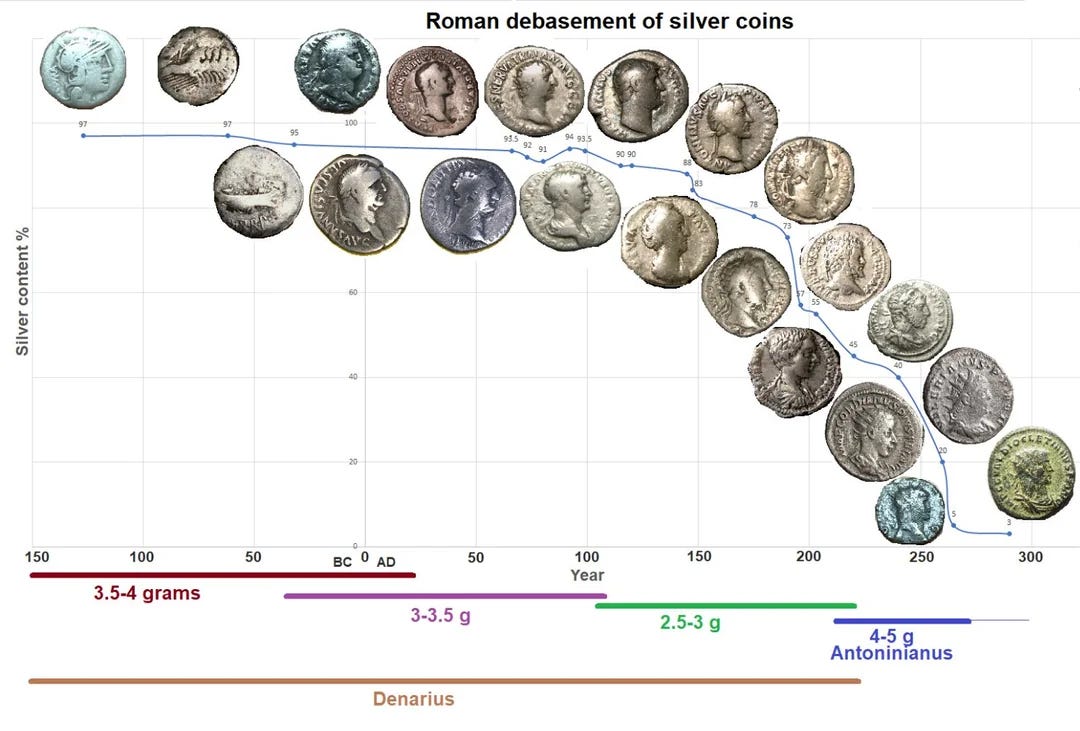
150 years after Julius Caesar and his heir Octavian (later Augustus) established the Roman Empire, Roman emperors began to devalue their currency.
Faced with the massive costs of wars abroad and welfare spending at home—both to maintain social cohesion and imperial dominance—the silver content of their coins was progressively diluted.
The denarius was roughly 94% silver under Nero (around AD 64) and remained relatively high-purity into the early 2nd century, but by the late 3rd century, its silver content had plummeted to under 5% with coins consisting of bronze or copper with only a thin silver layer.
This may sound familiar to modern readers. There is indeed an analogy between Rome’s currency debasement and the money creation practiced by the United States and other modern states.
But there is a crucial difference that has so far staved off a full-scale collapse, especially for the US: the petrodollar.
Before examining the petrodollar—and its links to the modern Middle East—we need to first look at the plain old dollar.
Paper and Gold
Since the 1930s, the US dollar has lost 99% of its purchasing power versus gold.
Events that accelerated this erosion include:
World War I, the creation of the Federal Reserve (1913), and the beginnings of large-scale deficit spending and central bank management of the currency.
The expansion of deficit spending as governments adopted Keynesian policies after the Great Depression and during World War II.
The Nixon Shock of 1971, when the US ended dollar convertibility to gold, enabling faster money creation to finance a rapidly expanding welfare state and other priorities.
The Middle East oil embargos of the early 1970s, in retaliation for US military support of Israel.
Unprecedented stimulus spending first in 2008 after the Great Recession and then in 2020 and 2021 after lockdowns.
Oil embargo 2026?
These policy choices have generally inflated asset prices—benefiting owners of stocks, real estate, and other financial assets—while making life more expensive for middle- and working-class wage earners whose real incomes have often lagged.
Note how the stock market did really well during lockdown whilst millions plunged into poverty, unemployment, and under-employment around the world.
If the result of a policy is defined as its goal, it is obvious that lockdowns were not designed for any health benefits (quite the contrary) but as a global exercise in wealth transfer from the masses to the global elites.
Equally, note how Trump said recently he did not want to make housing too affordable because that would hurt the Boomer Generation whose properties have made so many of them rich, along with their pension funds which have ridden massive growth in equities as they rode the money-printing wave of the last few decades.
Yes, items like cars and TVs have gotten cheaper, but healthcare and education and housing has generally ballooned in many parts of the world. In Britain and the US, the majority has never really caught up after 2008. The unemployment figures are lies, discounting those who have given up and counting Uber-style ‘gig’ jobs as worth the same as steady wages.
Through all of this, the tacit ‘social agreement,’ certainly in the first world, has been: accept higher taxes and inflation; accept open borders to suck up some of the inflation and suppress wages; and in exchange, some of you will get welfare benefits. Meanwhile, the stock market and GDP will go up.
Catholic writer, Hilaire Belloc, writing in 1912, foresaw this new polity and named it ‘the servile state.’
The Petrodollar
You might think this would lead to a Zimbabwe-like state of affairs in the first world. You might wonder how this has been avoided.
Surely, by now, with nearly $40 trillion of debt, the US should have fallen, closed their bases, and shuttered the welfare spending which takes up around half of their annual expenditure.
The reason why this has not happened is the petrodollar. And this, along with the Israeli influence I wrote about at the outset of the Iranian War, is the reason the US is obsessed with the Middle East.
No, they don’t hate radical Islam. They love it. They arm radical Sunnis in Syria, Saudi Arabia, parts of Russia, and formerly in the Balkans. Because they help them sell their greatest export: cash.
The oil, as I will explain, is primarily the means to export the dollar. Remember the US is a net energy exporter.
This, along with Israeli state capture of the US, is why you have all those military bases surrounding Iran in Sunni authoritarian territory, because the petrodollar is what is staving off a Roman-like collapse of the Global American Empire (the GAE)...
The deep foundations of the petrodollar first begun to be laid when the House of Saud began their conquest of Arabia. Britain was the major foreign power involved in the region at this time.
Britain was the dominant foreign power in the region during World War I, initially supporting the Hashemite dynasty (via promises made by T.E. Lawrence). However, the British ultimately stood aside as the House of Saud conquered key territories. Ibn Saud completed the unification of much of Arabia, and the Kingdom of Saudi Arabia was formally proclaimed in 1932.
The Saudis then cemented their radical, violent form of Sunni Islam called Wahhabism in the Arabian Peninsula, before it exporting it around the world. This directly led to 9/11 and the rise of ISIS.
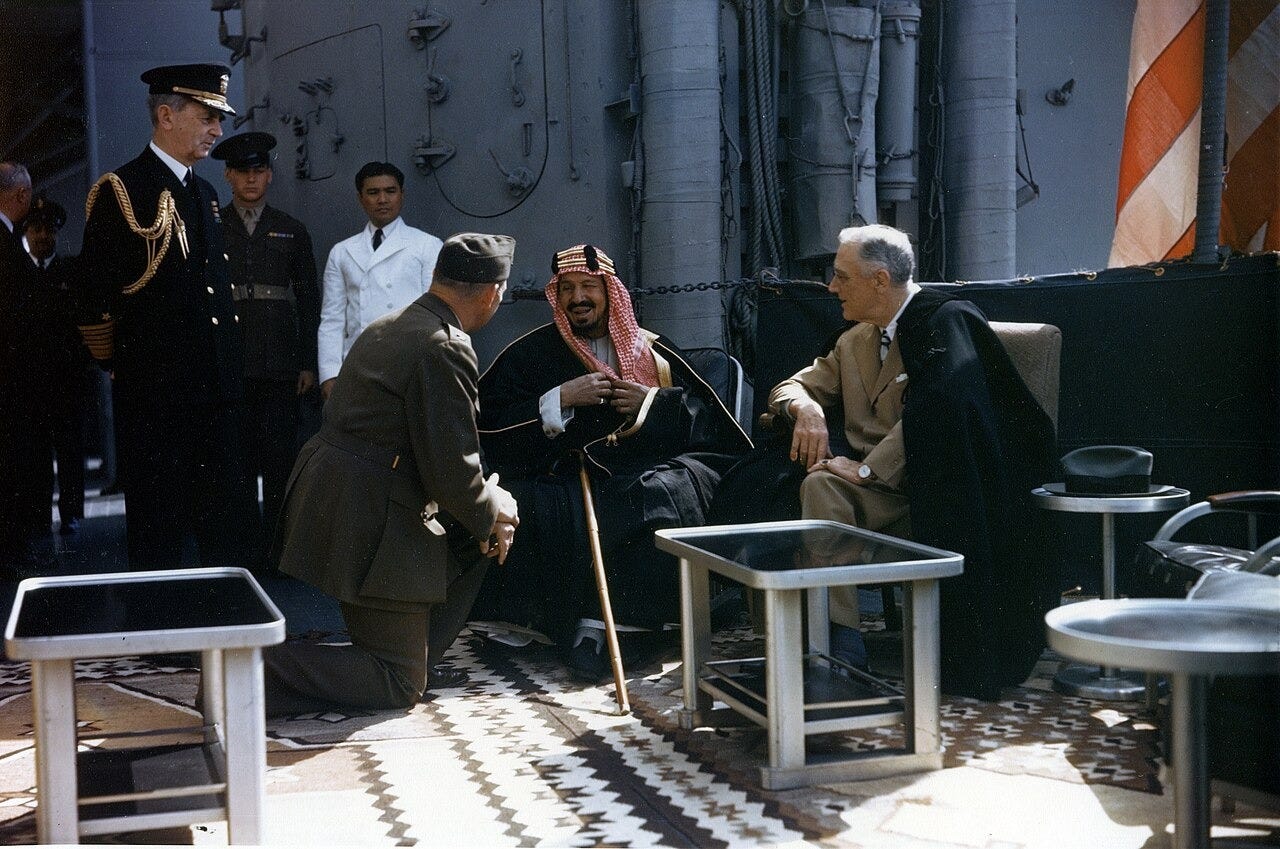
An informal US-Saudi alignment began in the 1930s over oil concessions. It deepened under President Franklin D. Roosevelt, who met King Ibn Saud aboard the USS Quincy in the Suez Canal in February 1945, establishing a security-for-oil framework.
This relationship meant that when Nixon collapsed the modern gold standard in 1971, and the Arab states embargoed oil in 1973, there was a kind of escape valve for the modern US dollar, even as the printing accelerated.
By 1974, Nixon’s Secretary of State, Henry Kissinger, would sign an agreement with the Saudis that oil would always be traded in dollars. Surplus dollars would then be reinvested in US bonds and assets.
By 1975, all of Opec (The Organization of the Petroleum Exporting Countries) was selling their oil in dollars.
In exchange, the US placed these states under their security umbrella. This would, of course, become quite complicated when Iran became an anatagonist state after their 1979 Revolution, followed by Venezuela when they swung dramatically to the left after the election of Hugo Chavez in 1999. Both Iran and Venezuela are founding states of Opec.
What did this mean for the US economy?
A lot.
Oil producing countries invest their dollars in American assets. Oil purchasing countries require dollar reserves to buy oil. These are so-called petrodollars.
Because of this global demand for dollars, the US can print money at Zimbabwe-like levels, without Zimbabwe-like inflation at home.
The dollars don’t sit inside the country, instead they are absorbed by countries all around the world, meaning the dollar remains the global reserve currency, and inflation is ‘shared’ with the planet and thus diluted.
Furthermore, when oil producing countries invest in US bonds, they lower the borrowing costs of the US government, and provide the money the US uses to fund their welfare state and their military.
(Many petrodollars also end up joining dollar deposits in Europe to become so-called ‘eurodollars.’)
The welfare state satiates the masses at home: particularly elderly Republican voters and poorer black Democrat voters. The military, aside from extending global influence, enforces the continuation of the petrodollar.
The money-printer stays ‘oiled’ and the debt racks up, inflating assets, yes, but not disastrously so. The Empire abides. The Pride flags go up in NATO countries and BLM and LGBT is taught in Africa and England.
All because the number one American export is dollars.
But what happens if this global demand for dollars begins to dry up… ?